
Six Things, Volume 149
Aerophor | Lego | Bouba-Kiki | Met Art | Dartboards | List Animals

Thing 1 – Aerophor
I’d love to meet a dodo. Also, for that matter, a Haast’s eagle or a Chatham penguin. And – if we’re doing this, which we seem to be – how about a Guadeloupe parakeet or a golden toad or a Steller’s sea cow or a quagga?
Alas. All gone.
These thoughts of extinct animals were prompted by two things. Firstly, I’ve been rereading Last Chance To See by Douglas Adams and Mark Carwardine (as mentioned in last week’s Six Things).
But also, and rather more tangentially, this weekend I’m conducting Richard Strauss’ monumental Eine Alpensinfonie (An Alpine Symphony in English, or, if you want to show that you’re in the know, just ‘Alpine’).
To say that it describes a day of mountain climbing doesn’t do the piece anything like justice. Strauss had a great ability for descriptive composition – he devoted an entire piece, Symphonia Domestica, to portrayal of every aspect of his home life, and once made the extravagant claim that, if necessary, he could musically depict a knife and fork.
Who better, then, to write such a piece? He had a lot of compositional skill in his locker, and in Eine Alpensinfonie he took everything out of that locker and threw it into the music, from glowing sunrise to sombre nightfall and everything in between: woods, glaciers, streams, waterfalls, pastures, sunshine, fog, getting lost in the undergrowth, the uncanny atmosphere at the summit, and the most spectacular and alarmingly realistic storm scene in the musical literature. All wrapped up in a 50-minute orchestral extravaganza featuring a hefty string section, dozens of wind instruments, a shedload of percussion (including cowbells, wind machine and thunder sheet), an organ, two harps, and 12 offstage french horns who play for less than a minute near the beginning of the piece and are never heard again.
It’s thrilling, glorious stuff.
But what the hell does this all have to do with extinct animals?
Glad you asked.
At the beginning of the score, below the list of orchestral instruments, appears the following:
”The Samuels Aerophone is recommended to facilitate the long woodwind tied notes”.
And what, you further ask, is a “Samuels Aerophone”?
Glad, once again, you asked.
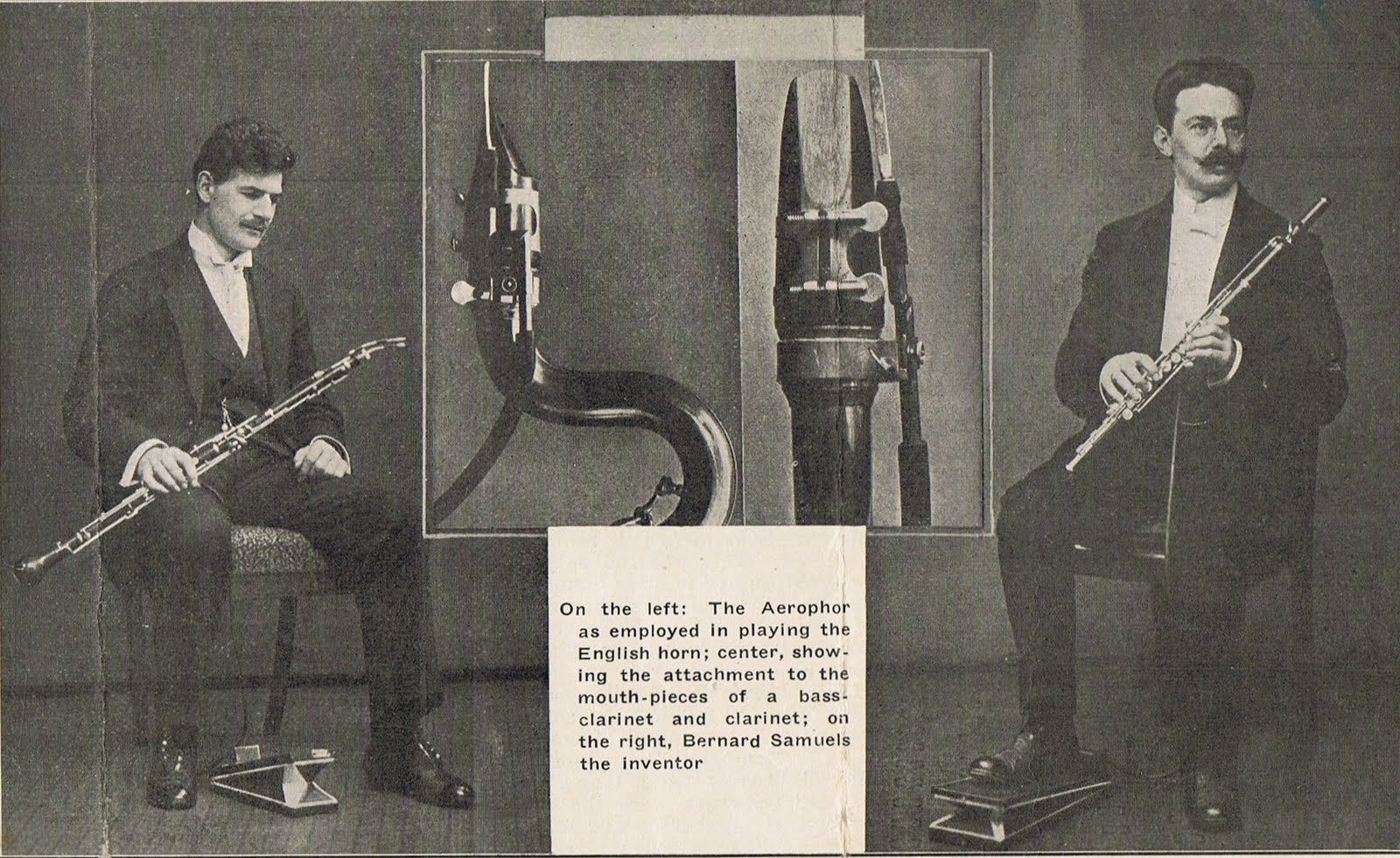
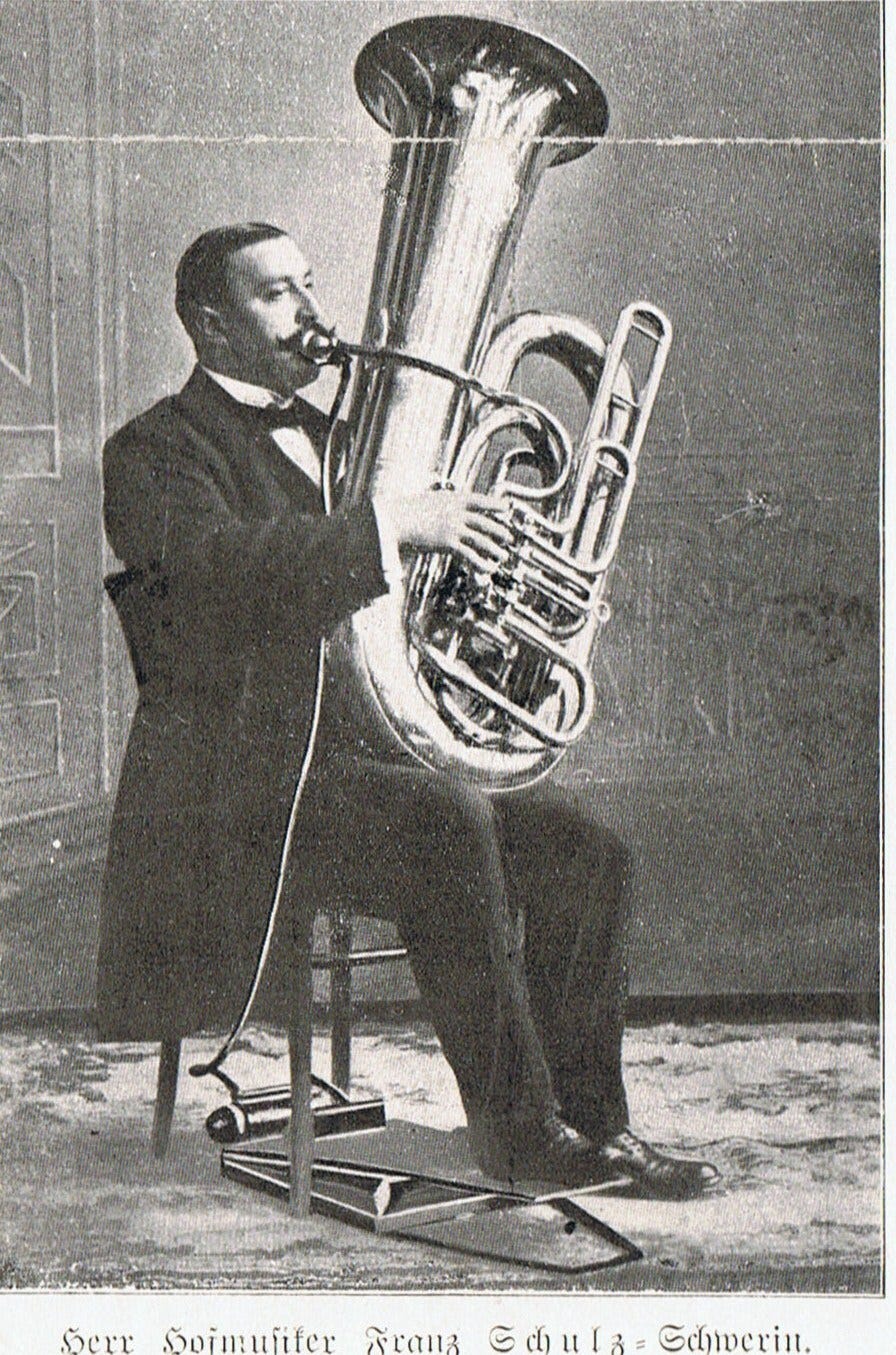
The Samuels Aerophone (or Aerophon or Aerophor or Aerophore – nobody can quite decide) was invented by Dutch flautist Bernard Samuels in 1912. It’s a device designed to help wind players play long notes without having to worry about the limitations of the human lung. A small foot-operated bellows connects to a rubber tube which leads to a mouthpiece – this sits in the corner of the player’s mouth, next to the instrument’s mouthpiece, and supplies air to the player. A water reservoir and electric light bulb make sure that the air supply is appropriately warm and damp, to match the player’s breath. Et voilà! Mechanical circular breathing. A magical device, which, according to this 1914 article, “will tinge the orchestra of the future with marvelous and hitherto unknown colors and will moreover serve a finer and more humanitarian end – it will conserve the player’s health and nervous energy.”
I’ve written all that in the present tense, as if the Samuels Aerophone (or Aerophon or Aerophor or Aerophore) is the kind of thing you can pick up at your local music shop.
Alas.
For the Samuels A (or A or A or A) has gone the way of the dodo, the quagga, the Guadeloupe parakeet and the Steller’s sea cow. For whatever reason, it never caught on. Perhaps the wind players of the day were resistant to change. Perhaps the technique of operating the footpump proved too much to deal with on top of the already onerous task of playing a musical instrument. Or perhaps it just didn’t work.
There are moves afoot to bring animals like the quagga back from extinction. I have mixed feelings about that. But if anyone wants to reconstruct the Samuels Aerophon/r/ne/re I’m all in.
Thing 2 – Lego Typewriter
Talking of gadgets…
The levels of invention, problem-solving and patience required to build a working Lego typewriter are several thousand levels above my paygrade. But that’s exactly what a Dutch YouTuber calling themselves Koenkun Bricks did. You can read a bit more about it here. And if that’s whetted your appetite, other Koenkun projects include a navigation system, a pool table and a skateboard.
Thing 3 – Bouba-Kiki
‘Bouba’ is round.
‘Kiki’ is spiky.
First observed by Georgian scientist Dimitri Uznadze (‘Uznadze’ is sort of soft and squishy, I think) in 1924, it’s a human intuition that holds reliably true across cultures and ages, and has long been thought a clue to the origin of language, something unique to humans.
Except that apparently chickens make the same connections as we do.
Thing 4 – Met Art

I’ve just spent a happy half-hour exploring this collection of high-definition 3D scans of art objects from the Metropolitan Museum of Art. The quality of the images is pretty amazing, and shows up well even on a phone screen.
Obviously going to see the real thing is the ideal, but if you’re prevented from doing so for reasons of geography or laziness, then this is a pretty good substitute.
Some favourites:
– Van Gogh Wheat Field with Cypresses
– Statue of Horus as a falcon protecting King Nectanebo II
– Standing Buddha with Radiate Combined Halo
Thing 5 – Dartboards

Ever wondered how the classic and familiar dartboard design came about? Ever wondered if there were any variations on it?
Thing 6 – List Animals

Pretty simple game, this. Just list all the animals. No cheating.
https://rose.systems/animalist
72 animals listed
🦁🐯🐆🐱℥🦉🐦🐦🐦🐦🐦𓅙🦜🦜🕷🐜🐕🦺🐄🐷🐏🐐🦤🦘🐨🐻🐼🐻🐻❄️🐻🐗🐟🐟🐟🦀🦀🦐🦞🦐🐳🐳🐬🐊🐊🐸🐸🐟🦂🦎🦅🐦𓅨🐦🐦🦅
I’d never heard of the Samuel’s Aerophone, and I’m all in for resurrecting it. I’m not surprised it was a flute player inventor, we waste so much air and frankly never keep up with the rest of the woodwind crew in long phrases! I’d deploy it all over the place. Love your Six Things - nothing better than filling my head with curios on a Sunday evening. Thank you!